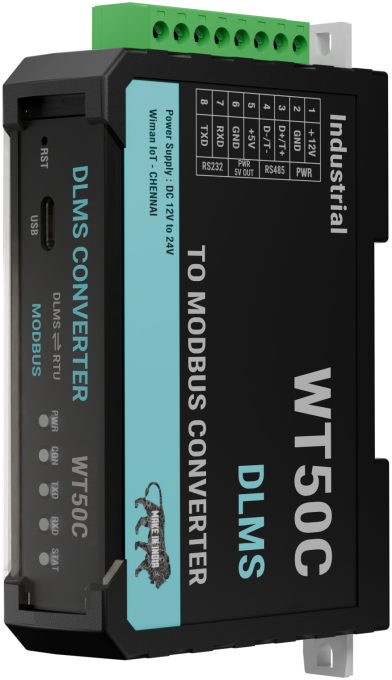
What does a DLMS to Modbus converter do?
Smart energy meters talk DLMS/COSEM (IS 15959), while most PLCs, SCADA systems, building management systems and data loggers talk Modbus. The WT50C reads the meter in DLMS on RS-232 and answers Modbus RTU requests on RS-485, so the master sees the meter as an ordinary Modbus slave.
Which energy meters does the WT50C support?
The WT50C carries meter profiles for Secure (Premier 300, Premier 350, Saral 305), L&T ER300P, HPL and Capital meters. The meter profile, meter address and meter password are set with the configuration tool.
Where is a DLMS to Modbus converter used?
Wherever a utility's DLMS billing meter has to report to a Modbus system: commercial buildings, IT parks, hospitals, hotels and malls on a BMS; factories and data centres on an energy management system; solar, wind and DG plants beside the inverters; water pumping stations and STPs; telecom towers; EV charging hubs; cold storage and warehouses; railway and metro stations; and utility substations, feeders and distribution transformers on SCADA.
Does the meter's communication port need its own power supply?
No. Pins 5 and 6 of the WT50C give 5 V DC to the meter's communication port, so nothing else is needed at the meter.
Which values can the Modbus master read?
The meter serial number; voltage, current and power factor on each phase; total power factor and frequency; active, reactive and apparent power; active and apparent energy (kWh, kVAh); and reactive energy, lag and lead (kvarh). All are Modbus input registers, read with function code 04.
How do I get the meter data to the cloud?
Poll the WT50C on RS-485 from a Wiman IoT gateway such as the WT460M (4G + LAN) or the WT400M (4G LTE). The gateway sends the readings on to your server or cloud platform.
Where do I get the configuration tool?
Through the Client Portal. The Windows configuration tool is not a public download; it is shared with customers in the portal.